
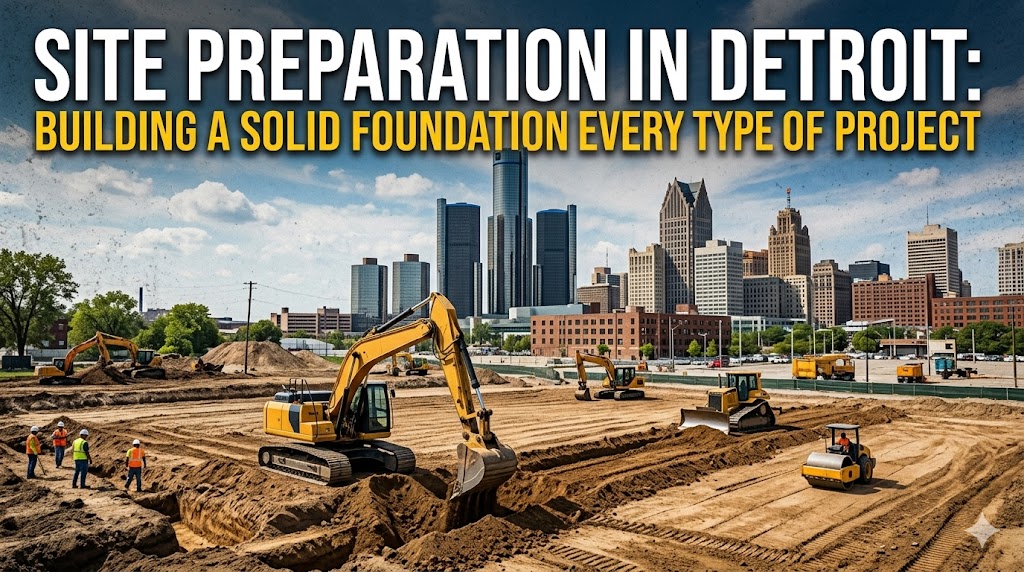
A building is only as good as the ground it sits on. A driveway is only as durable as the base beneath it. A landscaping project only performs as well as the soil and drainage system that support it. In every case, what happens before construction begins the Site Preparation Detroit phase determines how well the finished project will hold up over years and decades.
In Detroit, where the soil conditions, drainage infrastructure, and the legacy of previous land uses all create complex challenges, professional site preparation is the foundation upon which successful projects are built. Understanding what site preparation involves and why each of its components matters is essential knowledge for any property owner or developer working in the Detroit metropolitan area.
What Is Site Preparation?
Site preparation is a broad term that encompasses all the work done to transform raw, undeveloped, or previously used land into a condition suitable for construction, landscaping, or another intended use. It is the bridge between a piece of land as it exists today and the project that will occupy it tomorrow.
In practice, site preparation typically includes some combination of clearing and grubbing, demolition of existing structures, soil testing and analysis, grading and leveling, compaction, drainage installation, and utility infrastructure setup. The specific combination of activities required for any given project depends on the current condition of the land and the requirements of the planned development.
The Components of Site Preparation
Site preparation is best understood as a sequence of interconnected activities, each of which builds on the one before it.
Land clearing and grubbing is typically the first physical activity. All vegetation, trees, stumps, roots, and surface debris are removed to create a clean working surface. In Detroit’s urban context, this may also include the demolition of existing structures, removal of old pavement and foundations, and excavation of buried debris or contaminated soil.
Soil testing follows clearing. Understanding the composition, bearing capacity, and drainage characteristics of the native soil is essential for designing the appropriate foundation system and sub-base structure for whatever is being built. In Southeast Michigan, soils vary considerably some areas have well-draining sandy loam, while others are dominated by heavy, expansive clay that requires special handling to perform adequately under a structure.
Grading and earthwork reshape the land to the elevations and drainage patterns required by the project. This phase establishes the final contour of the site and ensures that water flows in the intended direction away from structures, toward drainage systems, and off the property in a controlled manner.
Sub-base preparation involves the placement and compaction of engineered fill, crushed aggregate, or other base materials over the native soil to create a stable, load-bearing platform for the planned construction. Proper compaction is critical insufficiently compacted sub-base material settles under load, causing pavement and structure failures that can be expensive to correct.
Drainage installation is often integrated with grading and sub-base work. French drains, catch basins, storm sewer connections, and surface swales may all be installed during the site preparation phase to ensure that the finished project manages water effectively.
Site Preparation Challenges Unique to Detroit
Detroit presents a set of site preparation challenges that reflect both its geography and its history.
Soil variability is a persistent challenge. The glacial origin of much of Southeast Michigan’s soils means that composition can change significantly within a short distance from well-draining sands to impermeable clays, sometimes within the same parcel. Thorough soil testing and a flexible approach to sub-base design are essential for navigating this variability.
Legacy contamination is a reality on many Detroit-area sites. Decades of industrial and commercial activity have left behind soil and groundwater conditions that require assessment and remediation before construction can proceed. Phase I and Phase II Environmental Site Assessments are standard practice for former industrial or commercial sites, and contaminated soil management is regulated by EGLE under Michigan’s Part 201 environmental response rules.
Buried infrastructure is another common challenge. Detroit’s age means that many properties have buried utilities, old foundation systems, cisterns, fuel tanks, and other subsurface remnants of previous occupancy that are not always well documented. Discovery of these features during site preparation requires careful assessment and, in some cases, specialized removal or containment procedures.
The city’s aging stormwater infrastructure also affects site preparation planning. In neighborhoods where sewer systems are old or at or near capacity, site preparation must account for the on-site management of stormwater runoff rather than simply directing everything to the municipal system. Green infrastructure approaches such as rain gardens, bioswales, and permeable pavement are increasingly integrated into site preparation plans as a result.
Site Preparation for Different Project Types
The specific activities involved in site preparation vary according to the type of project being planned.
For new residential construction, site preparation focuses on clearing the lot, establishing the building pad elevation, installing foundation drainage, and connecting to municipal utilities. In Detroit’s infill construction context where new homes are often built on lots surrounded by existing residences special attention is paid to managing drainage in ways that do not adversely affect neighboring properties.
For commercial and industrial development, site preparation is typically more extensive, involving larger areas, heavier loads, and more complex utility and drainage requirements. Environmental assessments are more commonly required, and the standards for grading, compaction, and drainage are more stringent.
For road and infrastructure projects, site preparation involves establishing the roadway corridor through clearing and grubbing, performing detailed geotechnical analysis of the sub-base, and installing drainage systems before any pavement is placed. The long-term performance of roads is closely tied to the quality of the site preparation work done before paving begins.
For landscaping and outdoor improvement projects, site preparation focuses on creating the right soil conditions, drainage, and grade for healthy plant growth and functional outdoor spaces. This may involve regrading a residential yard, installing a drainage system, or amending the soil’s composition before planting begins.
The Role of Professional Expertise
Site preparation is not a DIY undertaking for any project of meaningful scale. The combination of specialized equipment, technical knowledge of soil mechanics, familiarity with local regulations, and experience managing the unexpected conditions that routinely arise during earthwork all require professional expertise.
In Detroit, contractors with deep familiarity with the city’s diverse neighborhoods, soil conditions, and regulatory environment bring significant value to site preparation projects. This local knowledge understanding how different districts drain, where contamination is most commonly encountered, how the city’s permitting process works translates directly into more efficient project delivery and fewer costly surprises.
Final Thoughts
Site preparation in Detroit is a comprehensive and technically demanding process that establishes the foundation for successful projects of every type and scale. It encompasses clearing, demolition, soil work, grading, drainage, and compaction all performed in the right sequence, with the right equipment, and in compliance with applicable regulations.
The investment made in thorough, professional site preparation pays dividends throughout the lifetime of whatever is built on that land. Structures that are properly prepared for settle predictably, drain correctly, and endure the demands of Michigan’s climate without the chronic maintenance problems that result from shortcuts taken at the beginning.